

Hey, I’m Angela!

I didn't arrive here by accident.
Helping people has never felt like a career choice to me. It's felt like a calling, one that was shaped long before I ever set foot in a classroom.
I grew up knowing what hardship looks like from the inside. And from a very early age, I was the kid who felt others' pain as though it were her own, the one people came to, the one who sought out those who were struggling. That drive never left. What's evolved is my understanding of where it came from and what to do with it.
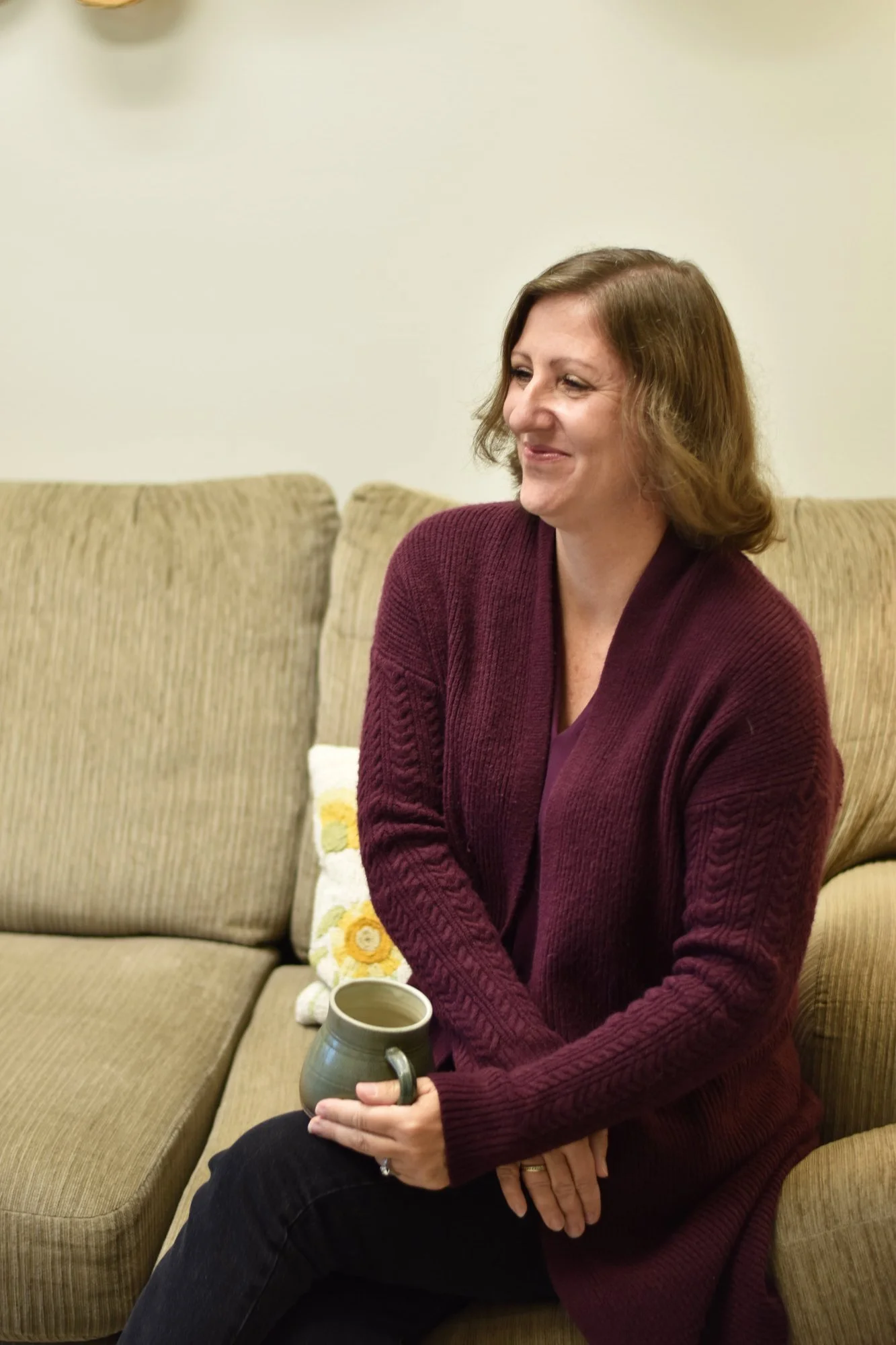
My journey into private trauma therapy work
I've been working in the social services field since 1999, when I completed my three-year diploma in Behavioural Science. Over the years, I've worked with individuals with an acquired brain injury, children who are autistic, families navigating life with a child on the autism spectrum, and seniors experiencing social isolation.
I returned to school later on in life to further add to my competencies, completing my BSW and MSW at Carleton University. It was during a placement with a Family Health Team in my master's program that I knew I was meant to do private practice. Clients told me that something felt different when they were with me, they felt safer. They told me they were able to go places they hadn't been able to go with other therapists. It was from those moments that I knew I wanted to work in private practice.
Today, I offer burnout and trauma therapy in Ottawa to adults who are ready to understand where their patterns come from and want to create new, healthier patterns for themselves and their relationships.
Some of the most formative years of my career were spent providing trauma and mental health support to people navigating Substance Use Disorder, precarious housing, estrangement, and profound loss. They were some of the most resilient, hardworking, and humble people I have ever met. They taught me that progress is never a straight line, that it moves forward, then back, then forward again, and that what matters is that the ground gained is never fully lost.
-
I’ve worked in several group practices throughout my career and I've always valued the power of community, for clients and for therapists. Working in isolation is hard on anyone. Being surrounded by other practitioners, learning from different perspectives, and having support around you can change how you feel about doing this work.
Going out on my own was ultimately about alignment. I wanted to build a practice that fully reflects my values and beliefs, one where the focus stays on the people I'm working with, how to help them best, and what we need to do together to get there. Working independently gives me the freedom to do that without compromise.
A powerful tool not widely available in Ottawa
Most people searching for trauma therapy have heard of EMDR. Fewer have heard of Accelerated Resolution Therapy (ART), and that's exactly why I want to talk about it here.
I was trained in EMDR in 2021 and used it successfully for about a year. Then my brother and sister-in-law, both therapists, introduced me to ART. They described it as more focused and directive, faster to get results, and more effective at shifting the body's physical response to trauma. I signed up for the next available training.
ART is not something I use with every client or in every session, but when it's the right fit, what I've witnessed it do changes the way I think about trauma therapy entirely. It's one of the most effective tools available, and it's not widely practiced here. If it's something that could help you, I want you to know it's available.
-
The results have been some of the most meaningful moments of my career.
In clients' own words:
One client shared that after a few ART sessions, it was the first time in nearly a decade they hadn't experienced suicidal ideation
Others have found that the memory itself becomes difficult to retrieve, and that placing responsibility where it truly belongs finally feels possible
Another described the process as breaking the chains that kept them attached to their trauma; the memory remained, but the emotional weight of it lifted
A client said the eye movements gave their brain just enough distraction to move through the event from start to finish without getting frozen at the worst moments, something they had never been able to do in talk therapy
-
ART works on a spectrum. For some people, the results are profound and rapid. The memories and pain don’t come up as often, memories are not as intense, and emotion dysregulation doesn’t last as long.
For others, it creates a more manageable distance from the pain. In either case, it allows people to make sense of their own responses and to understand that how they survived was exactly right for the circumstances they were in.
The things I want every client to know
Most of us were never taught how to understand our emotions. Not what they feel like in our bodies, not what they're trying to communicate, not how to move through them without shutting down or exploding. We made it to adulthood, expected to know all of this, and nobody showed us how. Understanding that gap is often the thing that starts to dissolve self-blame.
-
One of the most common things I hear in therapy is some version of: I should have known better. I should have seen it coming. I should have left sooner.
This is hindsight bias, judging past decisions using information we only have now. It's one of the most painful and least fair things we do to ourselves, and most of us do it constantly.
Part of my work is helping clients separate what they knew then from what they know now, and redirect that energy toward what they've learned and how they want to move forward. That shift alone can be transformative.
-
So much of what keeps us stuck is an invisible set of rules we inherited, about timelines, about success, about what it means to be a good partner or parent or person. Many of these rules were never ours to begin with.
In therapy, we move away from black and white thinking and into the grey zone. We get curious about which values and beliefs actually fit you and which ones you've simply been following out of habit or fear. Because living according to someone else's playbook is exhausting, and it keeps you from knowing what you actually need.
It is never too late to turn the page and write your next chapter. I believe that completely.

What I bring. What I need from you.
I show up to every session with each of the below:
01
Calm, curious, and non-judgmental
02
Deeply invested in your whole story
03
A way of making sense of things
What I need from you is this: a willingness to show up, a curiosity about feeling different, and a readiness to share what's been going on. Everything else we figure out together.
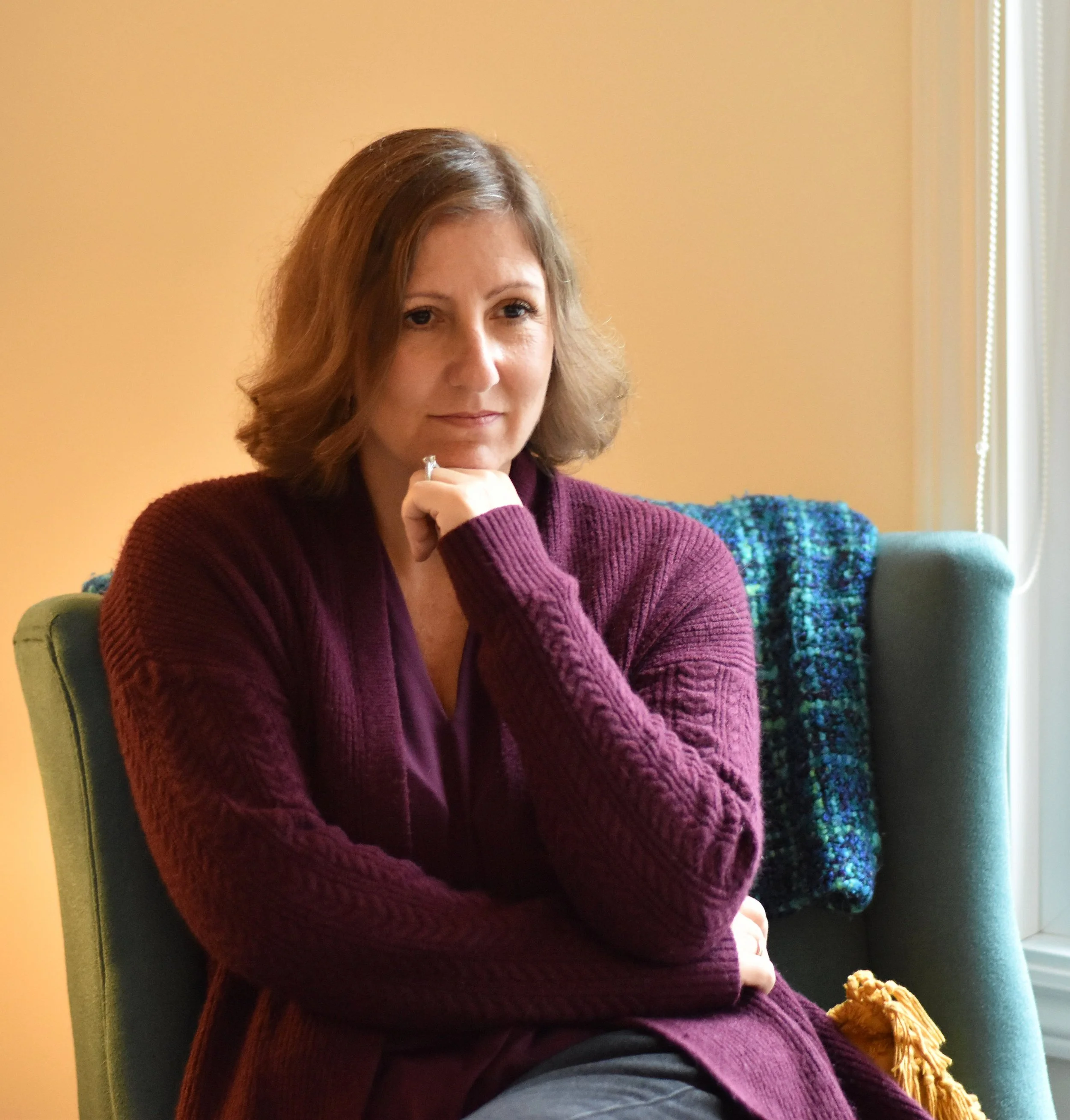
A little about the person behind the practice
Nature has always been where I reset. I spend as much time as I can in forests, near water, and in the mountains, kayaking, walking, and collecting whatever the Earth offers up. Semi-precious stones, sea shells, pine cones, acorns, tree bark, I've been gathering these things since I was a teenager, and I still come home from every walk with something new in my pocket.
There's something in that practice that echoes the work I do. When we slow down, use our senses, and get genuinely curious about what's around us, the world starts to reveal itself differently. I try to bring that same unhurried attention into every session.
Outside of that, I'm a mom, a partner, a board game fanatic, and someone who believes a good record and a quiet evening can solve almost anything. I also love a good debate and lively conversations with family and friends around important topics. And I remain a student of my own inner life, because I think its important to remain curious and open to change.
You don't have to have it all figured out to reach out.
That's exactly what the free consultation is for. Fifteen minutes, no commitment, no pressure. Just a conversation to see if this feels right.